Aluna: A Playful Script Handwritten Font for Makers
It started with a candle—just one, sitting on my workbench beside a half-printed label. I’d been testing fonts all morning for our new lavender-vanilla batch, and nothing felt quite right. Too formal. Too stiff. Too… not us. Then I opened Aluna.
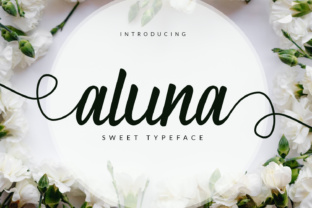
Right away, it felt like slipping into a favorite apron—soft, familiar, and full of quiet confidence. Aluna is a script handwritten font with gentle curves, airy spacing, and that effortless tilt you get from ink gliding across paper. It’s not fussy or overly ornate, but it’s undeniably stylish—youthful without being childish, luxurious without feeling distant. There’s warmth in every lowercase a, charm in each looping y, and just enough personality to make your product feel handmade, even before it’s touched by human hands.
I used Aluna first on candle labels—simple 2” x 3” rectangles printed on matte sticker paper. The font scaled beautifully at small sizes, and the letterforms held clarity even when shrunk to fit “Small Batch • Hand-Poured • Made in Oregon” along the bottom edge. No pixelation. No awkward gaps. Just clean, legible elegance. For larger applications—like a farmhouse-style welcome sign for a wedding suite or a printable wall art quote—I bumped up the size and let Aluna shine solo, no extra embellishment needed.
What makes Aluna especially practical for makers is how naturally it lives alongside other design elements. On greeting cards, it pairs effortlessly with a clean sans serif (think Montserrat or Inter) for body text—Aluna handles the name, title, or sentiment; the sans serif carries the details. For planner pages or digital printables, I often layer Aluna over soft watercolor textures or subtle linen backgrounds—it doesn’t compete, it complements. And on tote bags or mugs? It holds up surprisingly well in screen printing previews and SVG cut files, as long as I keep phrases short and avoid ultra-thin strokes in the design file.
Because Aluna is a display font—not meant for long paragraphs—it shines brightest where attention matters most: product names, taglines, invitation headers, boutique tags, holiday gift tags, and seasonal shop banners. I’ve used it for “Summer Solstice Collection” on a limited-run sticker sheet, “Hand-Tied Bouquet” on floral packaging ribbons, and “You’re Invited” on a rustic wedding invitation suite. Each time, it added that subtle lift—the kind that makes a customer pause, smile, and think, “This feels special.”
Readability is key, especially when cutting with Cricut or Silhouette machines. Aluna includes standard OpenType features like ligatures and stylistic alternates, which help smooth out tricky letter combinations (like “fl” or “th”) and add visual rhythm. I always test-cut a sample phrase first—“Wildflower Co.” works perfectly—and check that connecting strokes aren’t too delicate for my vinyl cutter’s blade width. For tiny stickers or jar labels under 12pt, I stick to uppercase or bold-weight variants if available, and avoid tight kerning. When in doubt, I open the font file to preview all included weights and styles—some versions include light, regular, and bold, while others offer swashes for extra flair on invitations or social media graphics.
Commercial use is straightforward, but I always double-check the license before adding Aluna to any digital download, printable template, or physical product. Most reputable script handwritten fonts—including Aluna—come with clear commercial licensing that covers physical goods (candles, shirts, mugs), digital products (PDF planners, Canva templates), and even resale-ready SVG bundles—as long as you’re not redistributing the font file itself. I also glance at multilingual support: if I’m designing bilingual holiday tags or packaging for international markets, knowing whether Aluna includes extended Latin characters (like é, ñ, ü) saves me from last-minute swaps.
For packaging design, Aluna brings cohesion. Our soap boxes, tea tins, and apothecary jars now share a consistent voice—not through identical layouts, but through that shared, hand-drawn ease. Customers don’t need to read the fine print to sense care; they feel it in the curve of the g, the balance of the o, the gentle slope of the baseline. That perceived quality isn’t accidental—it’s typography working quietly in service of craft.
And because Aluna is so versatile, it adapts to season after season. In spring, it dances across botanical-themed planner stickers. In fall, it wraps warmly around “Pumpkin Spice & Everything Nice” on mug designs. At Christmas, it adds a soft glow to “Joyful Moments” on printable gift tags. It never feels dated, never shouts—just listens, then responds with grace.
I’ve paired Aluna with everything from classic serifs (Cormorant Garamond for vintage wedding invites) to bold display fonts (Bebas Neue for contrast on shop banners) to other friendly handwritten fonts (for layered texture in digital mockups). But its sweet spot remains simple pairings: Aluna for the voice, a trusted sans serif for the structure. That balance keeps designs grounded, intentional, and easy to produce—whether I’m prepping files for print-on-demand, exporting PNGs for Etsy listings, or sending vector cuts to my local sign shop.
At the end of the day, Aluna isn’t just another script handwritten font. It’s a tool that helps translate intention into impression—turning “handmade” from a label into a feeling. Whether you're pressing wax onto a candle label, arranging text on a digital wall art preview, or choosing the final typeface for your shop’s banner, Aluna meets you where your creativity lives: thoughtful, tactile, and quietly joyful.