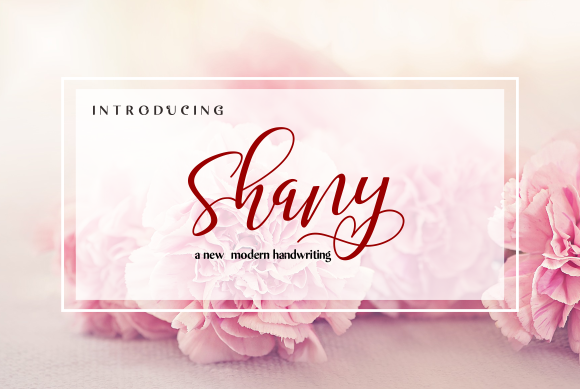
Shany Handwritten Typeface for Crafters & Sellers
As someone who hand-labels small-batch candles, designs printable wedding suites, and cuts vinyl stickers for local boutiques, I’ve learned that the right script handwritten font can quietly elevate everything — from perceived value to customer trust. That’s why Shany has become my go-to display font for projects where warmth, personality, and polish all need to coexist.
Shany isn’t just “cute” or “flowy.” It’s a modern handwritten typeface with intentional irregularity — letters tilt, strokes vary in weight, and curves feel spontaneous yet controlled. There’s a gentle “dancing” rhythm to it: not overly bouncy like some playful scripts, but alive enough to avoid feeling stiff or generic. It reads as relaxed *and* refined — perfect when your product needs to feel handmade without looking amateurish.
I use Shany most often for short, high-impact text: names on wedding welcome boards, boutique tags for ceramic mugs, seasonal packaging headers (think “Hand-Poured Vanilla” on soy candle labels), and greeting card titles. Its flowy letterforms hold up beautifully at 24–60 pt sizes on printed cards and cut vinyl. On Cricut and Silhouette machines, I’ve found it cuts cleanly down to 18 pt on matte sticker paper — especially when I simplify paths in Design Space or Studio first. For smaller applications like tea bag tags or mini gift stickers, I stick to single words or initials — “Joy,” “Luna,” “Est. 2023” — where Shany’s charm shines without sacrificing legibility.
What makes Shany truly practical for sellers is how well it balances expressiveness with clarity. Unlike ultra-decorative scripts that blur together at distance or in low-res mockups, Shany’s open counters and distinct letter shapes keep “A,” “R,” and “G” instantly recognizable — even in thumbnail previews on Etsy or Instagram. That matters when customers are scrolling fast. A “Thank You” tag in Shany feels personal, not cryptic. A “Farmhouse Fresh” sign using this font lands as authentic, not trendy-for-the-moment.
For digital printables — planner pages, quote art, wall decor bundles — Shany adds instant character without overwhelming layouts. I pair it with a clean, neutral sans serif (like Montserrat Light or Inter Regular) for body text or captions. That contrast lets Shany breathe as a focal point while keeping information scannable. In wedding stationery, I’ll set the couple’s names in Shany and use a soft serif (e.g., Cormorant Garamond) for details like date and location — elegant but never fussy.
Shany also works surprisingly well for product-based branding. I designed a line of herbal tea sachets where the flavor name (“Chamomile Calm”) appears in Shany on the front label, while ingredients and net weight sit in a crisp sans. Customers tell me the packaging feels “thoughtful” — like something they’d choose over mass-produced alternatives. That emotional resonance? It starts with typography that feels human-made, not algorithm-generated.
When preparing files for production, I always check if Shany includes alternate characters or swashes. Even one or two thoughtful ligatures (like “Th” or “Fl”) can add subtle polish to SVG files or layered digital templates. If you’re offering editable Canva templates or layered PSDs, those extras give buyers more flexibility without extra design work on your end. And yes — verify file formats. OTF and TTF are must-haves for compatibility across cutting software, Adobe apps, and web-based editors. If multilingual support is included (especially extended Latin characters), that’s a quiet win for sellers targeting broader markets or bilingual clients.
One thing I never skip: reading the commercial license. As a small shop owner selling physical products, digital downloads, and client-branded assets, I need fonts cleared for *all* those uses — not just personal projects. Shany’s commercial license covers physical goods (stickers, mugs, tote bags), digital templates, SVG cut files, and client work — no hidden restrictions. That peace of mind means I can confidently bundle it into editable wedding suite kits or offer it as a premium upgrade in my printable shop.
Real-world examples where Shany delivers: a chalkboard-style “Open Daily” sign for a coffee cart; foil-stamped “Handmade with Love” on kraft gift tags; minimalist holiday packaging with “Merry & Bright” arched over a wreath icon; planner cover pages where “My Year of Slow Living” feels both aspirational and grounded; and even subtle watermarking on social media graphics — its dancing rhythm catches the eye without shouting.
It’s not a font for paragraphs. Don’t try to set full invitation wording or ingredient lists in Shany alone. But as a display font, it’s exceptionally versatile — warm enough for baby shower invites, confident enough for artisanal soap labels, graceful enough for fine stationery. It bridges the gap between “hand-drawn charm” and “professional polish” in a way few script fonts do.
If you sell printables, cut files, or physical goods — especially anything where tone, trust, and tactile appeal matter — Shany earns its place in your font library. It’s not just another handwritten option. It’s a tool that helps your customers *feel* the care behind your craft — before they even touch the product.